
Why UV-Protected Cable Ties Matter Outdoors
The cable tie that an installer of solar farms has in his/her hand when securing hundreds of cables on a rack on the rooftop of a home is not the same type of nylon cable tie that an electrician will use to secure cables inside of a control panel. The sun will break down most plastics when they are outside, so if a standard nylon tie was laid out in the sun for months or worn by wind or rain, the tie will become brittle and lose its colour before eventually breaking — in some cases, in less than one year! On the other hand, a UV tie is manufactured using material that has been treated to resist UV rays, which enables the tie to keep cables secured and organised while they remain in an outdoor environment for many years. Understanding why the UV stabiliser is important, and how to correctly select the correct UV cable tie, is the difference between reliable installations and maintenance headaches that repeat themselves with every summer!
How Sunlight Destroys Ordinary Cable Ties
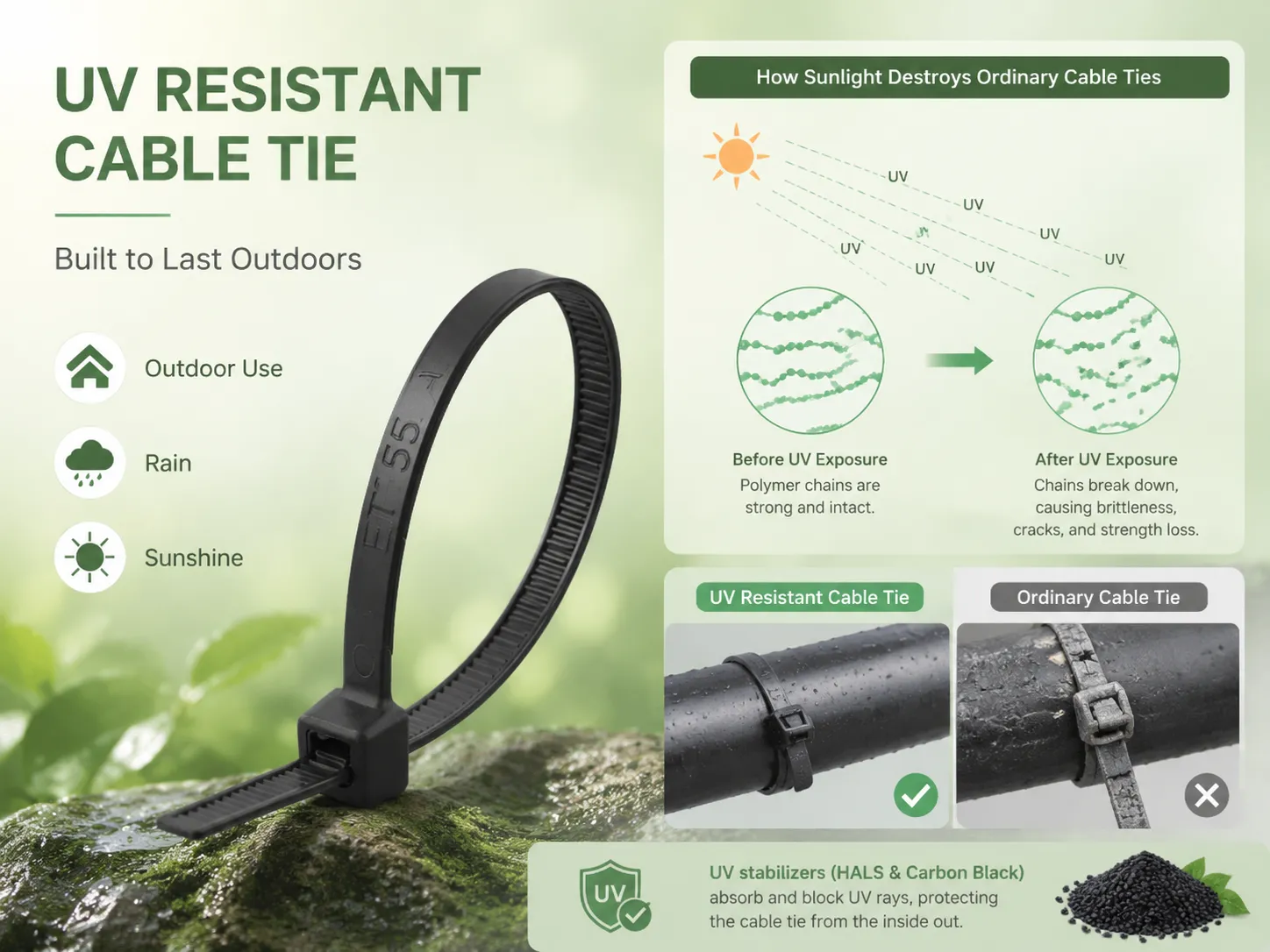
Damage originates from the effects of ultraviolet (UV) radiation, specifically from the UV-B and UV-A wavelengths that come to the surface of the Earth. When UV energy contacts the long chain structure of nylon (polyamide), it will break bonds between the chemicals in these polymers, known as photo-oxidation. When this occurs, the polymer chain structure becomes shorter, resulting in a loss of flexibility and the development of small cracks on the surface. In addition to the effects of UV on nylon, moisture and temperature variations can also accelerate the effects of damage. A typical nylon 6/6 cable tie that is not stated as modified and has been continuously exposed to the outdoor environment for one year can expect to lose more than half its tensile strength as a result of degradation caused by UV exposure. The American Chemistry Council published research studies that show that the degradation of polyamides that are not protected from the outdoor environment is a well documented form of damage; the most effective way to increase the service life of polyamides is to use stabilizers.
Cable ties that protect against UV rays have chemical stabilisers (mostly hindered amine light stabilisers (HALS) and/or carbon black) which absorb or quench the UV energy before it damages the polymer that forms the cable tie. The most common and effective UV stabiliser for outdoor-type plastics is carbon black because it can both shield and act as a radical trap against UV energy. Therefore, outdoor rated cable ties are usually black. The stabiliser is blended with the nylon resin prior to the manufacture of the tie and therefore it provides protection throughout the entire thickness of the cable tie, not just on the surface.
How Long Do UV-Resistant Cable Ties Last?
There is no single answer, because outdoor life depends on the specific climate. In a temperate northern climate, a high‑quality black UV‑stabilised nylon 6/6 cable tie can last 5 to 10 years or more. In a desert environment with extreme UV and temperature cycling, the service life may be closer to 3 to 5 years. In a marine environment with salt spray on top of sunlight, the combination of UV and chemical attack can shorten life further. Manufacturers often test their UV‑stabilised ties to accelerated weathering standards such as ASTM G154 or ISO 4892‑2, which use xenon‑arc or fluorescent UV lamps to simulate years of outdoor exposure in weeks. A data sheet that references these standards, along with the retained tensile strength after exposure, is the mark of a product that has been engineered for outdoor use, not just dyed black. Leading cable tie manufacturers such as Panduit and HellermannTyton publish detailed weathering data for their outdoor‑rated products.
Which Cable Ties Are UV Resistant?
With regard to availability, UV-resistant cable ties are most commonly made from nylon 6/6 with a UV stabiliser, usually black in colour. Note, however, that while the tie’s black will be an indication that it has stabiliser, some black ties may not have stabilising pigments; therefore, to confirm that the tie is both UV resistant and acceptable for outdoor use, it should be marked as “UV-resistant”, “outdoor rated” or “weather resistant”, and you can be confident that you are purchasing a quality tie from a reliable supplier. Certain other materials possess inherent UV resistance without stabilizers, such as stainless steel cable ties which are also completely unaffected by UV so they will last for many years in extreme outdoor conditions, such as oil rigs, desert photovoltaic (solar) farms and chemical processing facilities. ETFE (Tefzel) cable ties are widely used in aerospace and in outdoor applications that incur high ambient temperatures, and they also possess outstanding UV resistance. Although polypropylene (poly propylene) cable ties containing UV stabilisers can be less expensive than nylon 6/6 cable ties and are therefore good for light-duty outdoor use, they are much weaker than nylon 6/6 and will degrade faster than nylon.
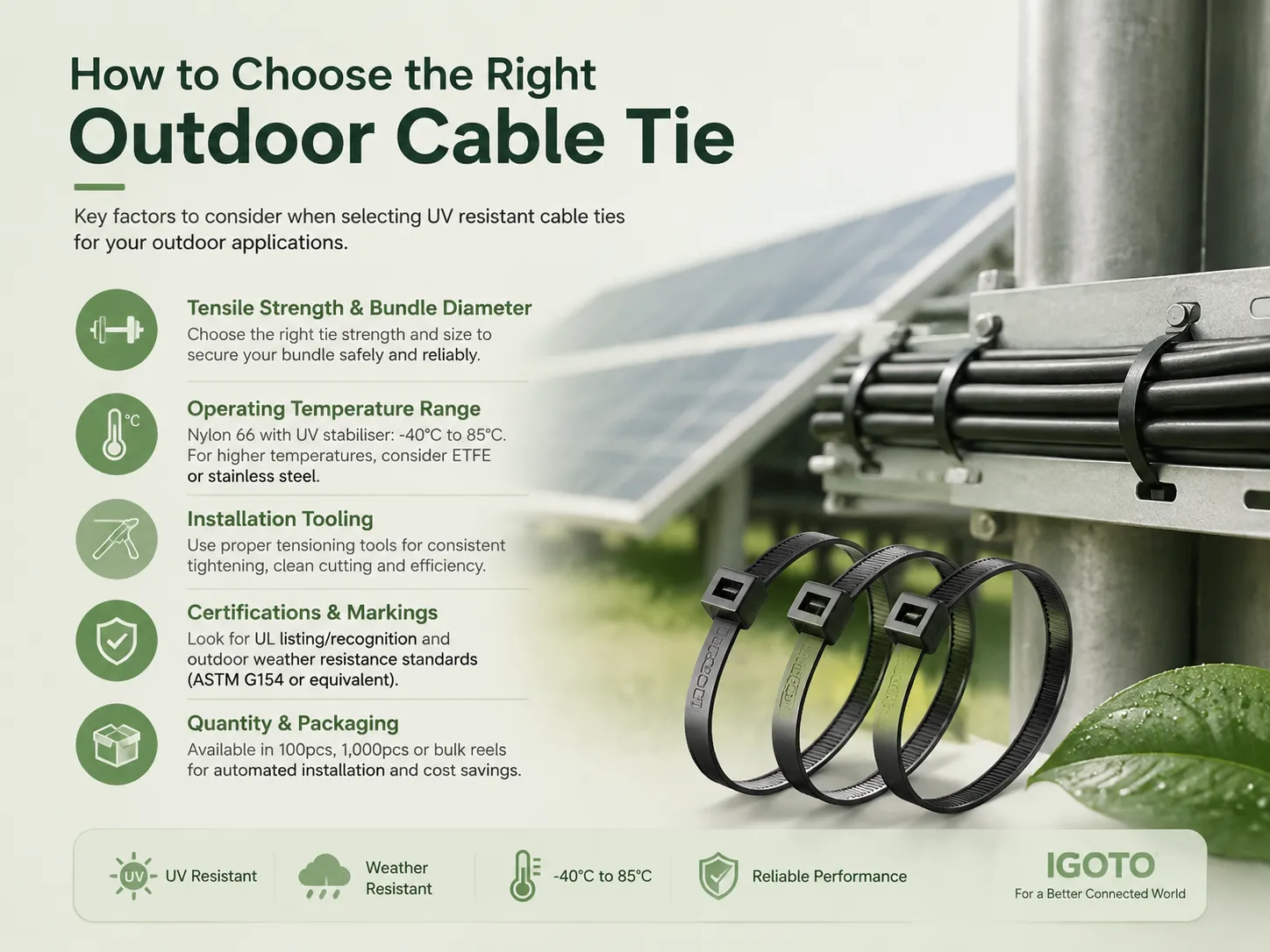
How to Choose the Right Outdoor Cable Tie
In order to select the best UV resistant cable tie for your outdoor applications, it is important to consider not only the UV rating of the product but also a number of other factors. Below are some of the additional considerations:
- Tensile strength and bundle diameter. Cable ties have ratings based on their tensile strength (in pounds or newtons) and their maximum bundle diameter. An 18-pound rated tie would be appropriately sized for use on a small bundle of low-voltage data cables; however, you would not use this same amount of weight to attach heavy armoured cables to a cable tray; therefore, you will need either a 50-pound rated tie or a tie rated at 120 pounds to secure these cables to a cable tray. You also need to consider the weight of the device you attach to when selecting your tie to ensure it can support the weight of the individual items without breaking off from the bundle or failing due to stretching.
- Operating temperature range. Generally, the operating temperature range of nylon 666 with UV stabiliser is between -40 and 85 degrees Celsius. In cases where temperatures will exceed 85 deg C, ETFE or stainless steel would be preferable materials .
- Installation tooling. Ties that you put on by hand can be used on a limited number of tie pieces. A tool is typically used to apply tension consistently and to cut off the excess tail in an accurate manner to provide speed and reliability in production or larger installations. Ties that work with tools are made by some manufacturers to work with their tensioning tools.
- Certifications and markings. When installing electrical equipment, you should search for fasteners that have either a UL label or UL recognition, especially if they’re used inside an electrical enclosure or to secure the wire in accordance with the National Electrical Code (NEC). UL-listed fasteners are tested for flame resistance and electrical performance. Fasteners used outdoors should also comply with an applicable weather resistance standard (ASTM G154 or equivalent).
- Quantity and packaging. Cable ties are typically packaged and sold in quantities of 100, 1,000, or as bulk reels that can be used with automated installation equipment. A contractor installing a large solar system may save significantly on labor costs, by purchasing from a B2B source such as igoto, than if they purchased their cable ties from retail stores in small packs.
How Much Do UV-Protected Cable Ties Cost?
The cost of a UV-protected cable tie depends on the size, the material, the quantity, and the brand. The following ranges are indicative for standard black UV‑stabilised nylon 6/6 ties.
| Cable Tie Size (Length × Width) | Tensile Strength | Approximate Price per 100 (Bulk) |
|---|---|---|
| 4 inch × 0.1 inch (100 mm × 2.5 mm) | 18 lb (80 N) | $1.50 – $4.00 |
| 8 inch × 0.14 inch (200 mm × 3.6 mm) | 50 lb (222 N) | $2.50 – $6.00 |
| 12 inch × 0.3 inch (300 mm × 7.6 mm) | 120 lb (534 N) | $5.00 – $12.00 |
Stainless steel ties have a higher price tag (around a few dollars each) but are designed to be used in an outdoor environment permanently. ETFE ties are more expensive than nylon; however, they remain under $1 each for popular sizes when buying in bulk. Organizations that can buy in quantities of several thousand pieces can acquire these ties through suppliers like igoto that offer custom branding, custom lengths, and competitive pricing based on volume purchases. When comparing quotes from suppliers, ensure that the UV stabilised nylon ties you receive include all applicable test results and UL listing where applicable. A lower price without certified weathering will not necessarily provide savings; rather it creates the potential to fail at a time when the secured equipment is no longer functional.
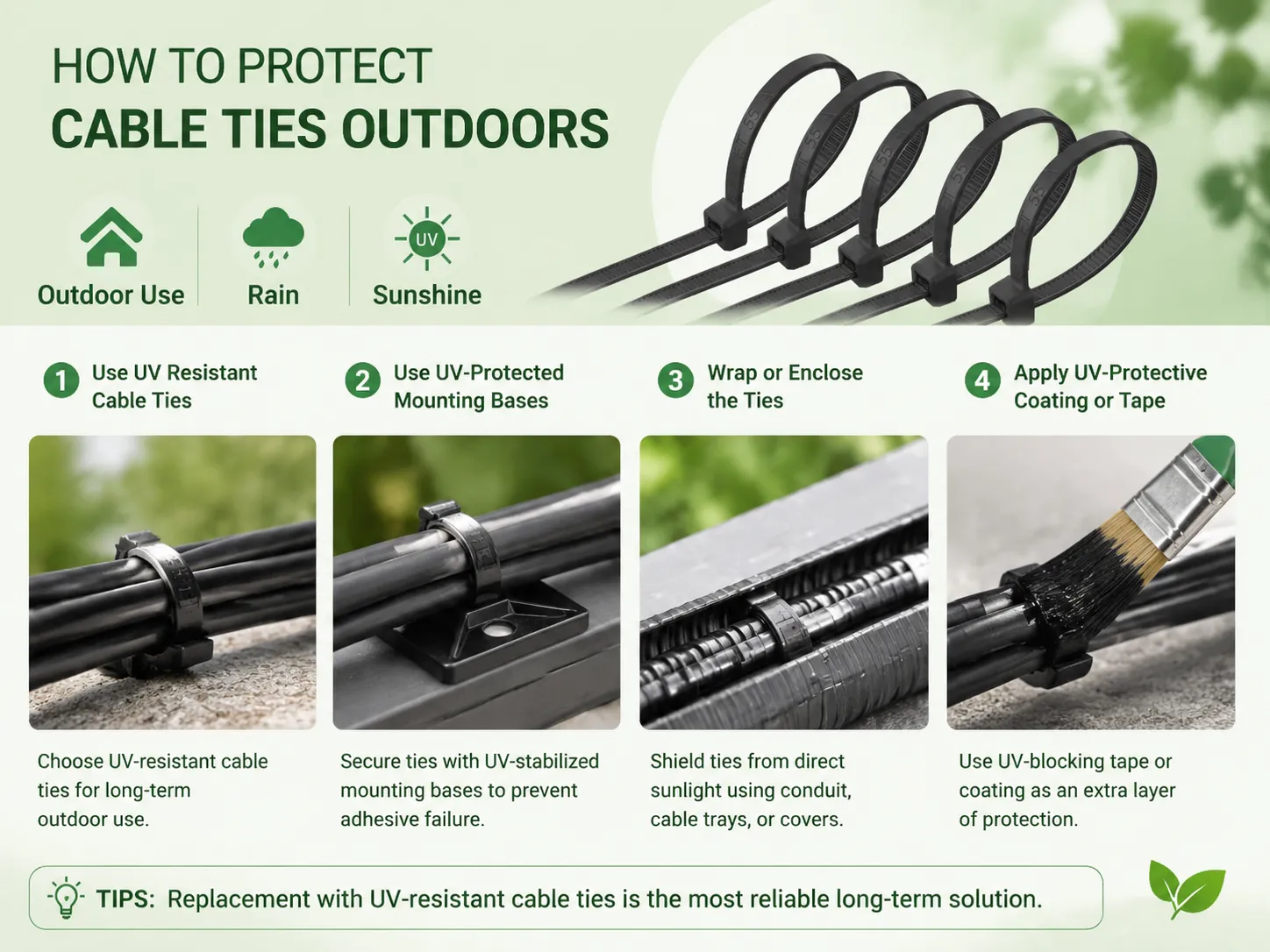
How to Protect Cable Ties That Are Already Installed
Use standard non-UV ties to fasten a cable run if it’s already been secured, or use practical ways to add protection to your outdoor cable installation.
- Use cable tie mounting bases with UV protection. UV stabilized, adhesive back mounting bases will help ensure that the ties will not disengage from the surfaces when the adhesive fails.
- Wrap or enclose the ties. At certain locations, you may want to protect cable ties from direct sunlight by either running their cable inside a conduit, using a cable tray or having a UV-resistant cover for the cable tray and/or by manufacturing a runaway UV muffler (which is effectively a whole lot of roof space) to further shield cable ties from the sun/ambient UV reflected off of objects and surfaces, although the intensity of ambient UV reflected onto the cable ties is significantly diminished.
- Apply a UV‑protective coating or tape. When you need to use specialized “UV” blocking cool tapes and/or paints on installed Ties, it can be done; however, it is a very labour-intensive process and usually not as reliable as replacing the ties with UV treated versions. For Ties that will be outside for extended periods of time, replacement is the best alternative.
Frequently Asked Questions
Which cable ties are UV resistant?
Cable ties Items are labelled “UV-resistant,” “weather-resistant,” or “outdoor-rated” which means that they can be used outdoors without fear of fading or deterioration. Typically, UV-resistant items will be black and made from nylon 6/6 that has UV stabilisers added. Other material types like stainless steel & ETFE Tefzel have an inherent resistance to UV light without adding any additional stabilisers.
How long do UV resistant cable ties last?
UV-resistant cable ties Lasting approximately 5 – 10 years in temperate climates. If exposed to extreme climates such as deserts, the lifespan could be reduced to 3 – 5 years. The length of life will depend on UV light intensity/Level >and Temperature cycling, along with stabilisation formulation specific to the stabilisation.
How to protect cable from UV?
A good way to avoid exposing cables to UV light is to use UV-stabilised cable sheathing, put cables in conduits or in covered cable trays, and/or put a protective UV coating on cables. For cable ties, the simplest and best way to protect your cable ties from UV exposure is to buy and use already UV-stabilised cable ties initially.
What zip ties don’t degrade in the sun?
Stainless steel zip ties Does sunlight cause any degradation whatsoever to the materials? Black UV stabilized nylon 6/6 ties and ETFE (Tefzel) ties are made to withstand sun degradation for years amongst plastic ties. Standard natural colored nylon ties will degrade quickly in an outdoor environment.
Can I use regular black cable ties outdoors?
All black cable ties are not uv resistant. A non-stabilizing pigment may have been used to create the black color. The only suitable cable ties to use for long-term outdoor applications are those that have been clearly marked “UV Resistant” or “Outdoor Rated” by their respective manufacturers. If a black cable tie package does not indicate that its product can withstand ultraviolet rays, assume that it is only intended for indoor use.
References
- American Chemistry Council — Plastics Division — Information on polymer degradation and stabilisation.
- Panduit — Outdoor Cable Ties and Weathering Data — Manufacturer of UV‑stabilised and stainless steel cable ties with published accelerated weathering results.
- HellermannTyton — UV‑Resistant Cable Ties — Global manufacturer of cable management products with outdoor‑rated options.
- ASTM G154 — Standard Practice for Operating Fluorescent Ultraviolet (UV) Lamp Apparatus for Exposure of Materials — The standard test method used to evaluate UV resistance of plastics.
Why UV-protected cable ties matter outdoors comes down to one fact: nylon without stabiliser dies in the sun. A tie that looks intact but has lost its strength is a failure waiting to happen — a cable drooping onto a hot surface, a bundle pulling loose in a storm, a solar array cable chafing against a rail. Specifying a black, UV‑stabilised, properly tested cable tie for every outdoor installation eliminates that risk at a cost of a few cents per tie. For the contractor, the facility manager, and the OEM, the question is not whether to use UV‑protected ties outdoors, but whether the tie on the cable is one that was built for the sun — or one that the sun will eventually break.